Getting a flat tire is never a pleasant experience, but getting one on a busy freeway is a whole different level of stressful. Freeways in the Greater Los Angeles area are some of the busiest and most congested roads in the entire country, with vehicles traveling at high speeds and very little margin for error. A flat tire in this environment is not just an inconvenience. It is a genuine safety emergency that needs to be handled carefully, quickly, and correctly to avoid putting yourself and other drivers at serious risk.
Short answer: If you get a flat on the freeway, hold the wheel steady, don’t brake hard, turn on your hazards and ease onto the right shoulder or the next exit. Stay in the car with your seat belt on, and don’t change a tire next to freeway traffic. If you’re stuck in a lane, call 911. For a tire change or tow, call (747) 877-8577.
The good news is that while a flat tire on the freeway is undeniably frightening, it is a situation that can be managed safely if you know what to do. The key is to stay calm, follow the right steps in the right order, and resist the urge to make any sudden or panicked decisions that could make the situation significantly more dangerous. Knowing in advance what to do if a flat tire strikes on the freeway can make all the difference between getting through the situation safely and making a dangerous situation even worse.
In this guide, we walk you through exactly what to do if you get a flat tire on the freeway, step by step, so you are prepared if it ever happens to you on a Los Angeles freeway or anywhere else in the Greater LA area.
How to Recognize a Flat Tire While Driving on the Freeway
Before we get into what to do, it’s worth understanding how to recognize that you have a flat tire while driving at freeway speeds, because the experience is quite different from discovering a flat in a parking lot.
A flat tire at freeway speed typically produces one or more of the following symptoms. You may hear a loud bang or a sudden explosive sound if the tire blows out suddenly. This is what is commonly referred to as a tire blowout, and it can be a startling and frightening experience. You may feel the vehicle pulling strongly to one side, to the left if the flat is on the left side of the vehicle, or to the right if it is on the right side. You may feel a significant vibration or shaking through the steering wheel, the seat, or the floor of the vehicle. You may also hear a loud flapping, thumping, or rumbling sound coming from one of your tires as the flat tire contacts the road surface.
If you experience any of these symptoms while driving on the freeway, it is critical that you respond quickly but calmly, following the steps outlined below.
Step 1: Stay Calm and Keep a Firm Grip on the Steering Wheel
The moment you realize you have a flat tire on the freeway, the single most important thing you can do is stay calm. A flat tire, particularly a sudden blowout, can cause the vehicle to pull sharply to one side and feel very unstable, which is an understandably frightening experience at freeway speeds. The instinctive reaction for many drivers is to panic, brake hard, or make a sudden sharp steering correction, and all of these reactions can make the situation significantly more dangerous.
Instead, keep both hands firmly on the steering wheel and maintain a straight course as best you can. Grip the wheel firmly but without tensing up completely. You need to maintain control while also being able to feel and respond to the vehicle’s movement. Focus on keeping the vehicle pointing straight ahead and resist any urge to make sudden or jerky steering inputs.
Step 2: Do Not Brake Suddenly
This is one of the most critical and counterintuitive pieces of advice when it comes to handling a flat tire at freeway speed, do not hit the brakes suddenly or hard. Sudden braking with a flat tire can cause the vehicle to become extremely unstable, potentially leading to a loss of control, a spin, or even a rollover in severe cases. The flat tire significantly reduces the vehicle’s ability to handle sudden changes in speed, making hard braking far more dangerous than it would normally be.
Instead of braking suddenly, gradually and gently ease off the accelerator to begin slowing the vehicle down smoothly and progressively. Let the vehicle decelerate naturally as much as possible before applying any brake pressure. If you do need to apply the brakes, do so very gently and progressively, never suddenly or aggressively. The goal is to reduce your speed gradually and in a controlled manner while maintaining as much stability as possible.
Step 3: Turn On Your Hazard Lights Immediately
As soon as you realize you have a flat tire, turn on your hazard lights immediately, even before you have fully stopped or moved to the side of the road. Your hazard lights alert other drivers on the freeway that something is wrong with your vehicle and that they should proceed with caution around you. This is particularly important on a busy Los Angeles freeway where other vehicles may be traveling at high speeds and may have very little time to react to a slowing or disabled vehicle ahead of them.
Keep your hazard lights on for the entire duration of the time your vehicle is stationary on or near the freeway. Visibility is absolutely critical in this environment, and your hazard lights are one of the most important tools you have for making your vehicle visible to other drivers.
Step 4: Steer Gradually Toward the Right Shoulder
Once you have your hazard lights on and you are slowing down in a controlled manner, begin gradually and smoothly steering your vehicle toward the right shoulder of the freeway. Use your turn signal to indicate your intention to move to the right so that other drivers are aware of your movement.
Take your time with this, do not make sudden or sharp steering movements. Guide the vehicle steadily and smoothly toward the shoulder, maintaining as much control as possible throughout. If there is an exit ramp nearby and you can reach it safely, taking the exit and getting completely off the freeway is an even better option than stopping on the shoulder, as it puts significantly more distance between you and fast-moving freeway traffic.
Aim to get as far to the right as possible, ideally completely off the paved surface of the freeway and onto the shoulder or beyond. The more distance you can put between your vehicle and the flow of freeway traffic, the safer your situation will be.
Step 5: Pull as Far Off the Road as Possible
Once you have reached the right shoulder, continue moving as far to the right as you safely can. Many drivers stop at the edge of the shoulder, but if conditions allow, pulling further onto a dirt area, an emergency stopping area, or beyond the white line on the right edge of the shoulder puts significantly more distance between your vehicle and passing traffic.
Every extra foot of distance from the flow of traffic matters enormously on a busy freeway. Studies and traffic safety data consistently show that vehicles and people on freeway shoulders are at significant risk of being struck by passing vehicles, particularly in low visibility conditions or during heavy traffic. Getting as far off the road as possible is one of the most important things you can do to protect yourself and your passengers.
Once your vehicle is as far to the right as you can safely get it, put the vehicle in park, apply the parking brake, and turn off the engine.
Step 6: Stay Inside Your Vehicle
Once your vehicle is safely positioned on the shoulder or as far off the road as possible, stay inside your vehicle with your seatbelt fastened. This may feel counterintuitive, many people’s instinct is to get out and assess the damage immediately, but on a freeway, staying inside your vehicle is almost always the safest choice.
A stationary vehicle on the freeway shoulder, even one that has been struck by another vehicle, provides significantly more protection than standing outside in the open near fast-moving traffic. Pedestrians on freeway shoulders are at an extremely high risk of being struck by passing vehicles, and this risk is present even when your hazard lights are on and your vehicle is clearly visible.
Unless your vehicle is in immediate danger, such as if it is on fire or in a position where it is about to be struck, stay inside with your doors locked and your seatbelt on and call for help from inside the vehicle.
If you absolutely must exit the vehicle (for example, if you have passengers who need to be moved to safety) exit from the passenger side of the vehicle, away from traffic, and move as far away from the road as possible. Never stand behind or in front of the vehicle.
Step 7: Call for Help
Once you are safely positioned and inside your vehicle, call for help. On a freeway in the Greater Los Angeles area, you have several options:
Call a Roadside Assistance or Towing Company: This is typically the fastest and most practical solution. A professional roadside assistance service can come to your location, assess the situation, and either change your flat tire if you have a spare available or tow your vehicle to the nearest tire shop or repair facility if a spare is not available or the damage is too severe for a simple tire change. In North Hollywood and the surrounding Greater LA area, Rosario Swift Towing Services is available to help. Give us a call at (747) 877-8577.
Call 911 if Necessary: If you or any of your passengers are injured, if your vehicle is in a position that poses an immediate danger to other drivers, or if you feel unsafe for any reason, call 911 immediately. California Highway Patrol also patrols the freeways and can be called for assistance in freeway breakdown situations.
Use the Freeway Call Box if Available: Many California freeways have emergency call boxes located at regular intervals along the shoulder. If you are near one and cannot use your phone, these call boxes connect directly to emergency services and can be used to request assistance.
When you call for help, be ready to provide your exact location on the freeway (including the freeway number, the direction of travel, and the nearest mile marker or exit) so that help can reach you as quickly as possible.
Should You Change the Tire Yourself on the Freeway?
This is a question many drivers ask when they get a flat tire on the freeway: and the honest answer is that in most cases, changing a tire yourself on a busy freeway shoulder is not recommended, even if you know how to do it and have a spare tire available.
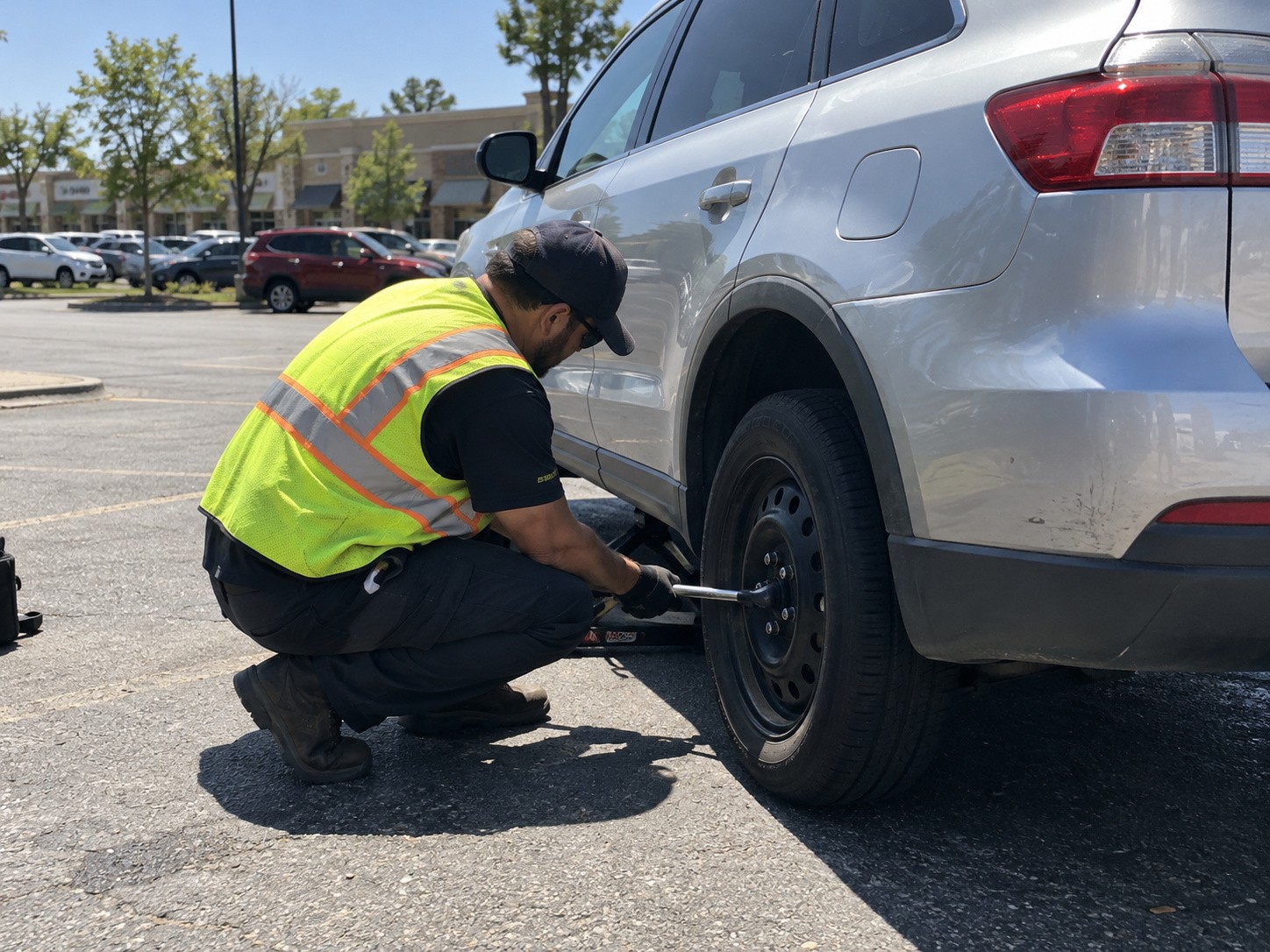
Changing a tire requires you to exit the vehicle, work outside in close proximity to passing freeway traffic, and spend a significant amount of time crouching down next to the vehicle at road level, all of which puts you at serious risk of being struck by a passing vehicle. The risk is particularly high on busy Los Angeles freeways where traffic volumes are high and vehicles travel at speed.
If you are in a situation where you have managed to get your vehicle completely off the freeway and into a genuinely safe location, such as a wide emergency stopping area or well away from the road, and if the conditions are safe, you may be able to change the tire yourself. However, if there is any doubt about the safety of your surroundings, calling a professional roadside assistance service to change the tire for you is the much safer option.
A professional tire change service means you stay safely inside your vehicle while a trained and experienced technician handles the tire change in a safe and efficient manner. The relatively small cost of a professional tire change service is well worth it compared to the risk of attempting to do it yourself on a busy freeway.
What to Do After the Flat Tire Has Been Resolved
Whether your flat tire was resolved by a professional tire change service, by changing the tire yourself in a safe location, or by having your vehicle towed to a tire shop, there are a few important steps to take after the immediate situation has been resolved:
Visit a Tire Shop as Soon as Possible, If your flat tire was resolved by installing a spare tire, particularly a compact temporary spare, also known as a donut, visit a tire shop as soon as possible to have a proper replacement tire fitted. Compact spare tires are only designed for short-distance, low-speed driving and should not be used for extended periods or at freeway speeds.
Have the Damaged Tire Inspected: Even if the damaged tire appears to be repairable, have it professionally inspected by a tire specialist before making a decision. Some types of tire damage, particularly sidewall damage and blowouts, cannot be safely repaired and require the tire to be replaced entirely.
Check Your Remaining Tires: A flat tire is often a sign that your tires may be due for inspection or replacement. While you are at the tire shop, have your remaining tires inspected for wear, damage, and proper inflation. Catching potential tire problems early can help prevent another flat tire down the road.
Restock Your Spare Tire: If you used your spare tire to resolve the flat, make sure to replace it as soon as possible so you are prepared if another flat tire occurs in the future. A vehicle without a spare tire is significantly more vulnerable in a flat tire situation.
How to Reduce the Risk of a Flat Tire on the Freeway
While flat tires can never be completely eliminated, there are several proactive steps you can take to significantly reduce the risk of experiencing one, particularly at the worst possible time on a busy Los Angeles freeway:
Check Your Tire Pressure Regularly: Properly inflated tires are significantly less vulnerable to damage and failure than underinflated or overinflated ones. Check your tire pressure at least once a month and before any long drive, and keep your tires inflated to the pressure recommended in your vehicle’s owner’s manual or on the sticker inside the driver’s door frame.
Inspect Your Tires for Wear and Damage: Regularly inspect your tires for signs of excessive wear, cuts, bulges, cracks, or embedded objects such as nails or screws. Catching these issues early allows you to address them before they lead to a flat or blowout on the road.
Replace Worn Tires Promptly: Tires that are worn down to or near the minimum tread depth are significantly more vulnerable to punctures and blowouts. Don’t wait until your tires are completely bald to replace them. If the tread depth is getting low, start planning for new tires before they become a safety hazard.
Avoid Road Hazards When Possible: While it’s not always possible to avoid every hazard on the road, being alert and aware of your surroundings can help you spot and avoid debris, potholes, and other road hazards before they cause damage to your tires.
Carry a Roadside Emergency Kit: Having a basic roadside emergency kit in your vehicle (including a properly inflated spare tire, a jack, a lug wrench, reflective triangles or road flares, and a flashlight) means you are better prepared to deal with a flat tire situation safely and efficiently if one does occur.
Getting Off the 170, the 101 and the 134 Safely
The freeways around North Hollywood have short merges and narrow shoulders in places, so the next exit is often a safer place to stop than the shoulder:
- On the 170, the boulevard exits lead to wide surface streets with room to pull over
- On the 101 near the Cahuenga Pass, the shoulders are tight. If you can keep rolling slowly, use the next exit
- On the 134 past Toluca Lake and Burbank, aim for the right shoulder, never the center median
Once you’re stopped, tell us the freeway, your direction and the last exit. Wait inside the car with your seat belt on, or behind the guardrail if it’s safe to get out.
Got a Flat Tire on a Los Angeles Freeway? Call Rosario Swift Towing Services.
If you have a flat tire on a freeway or anywhere else in North Hollywood or the surrounding Greater Los Angeles area, Rosario Swift Towing Services is here to help. Our experienced team provides fast, professional flat tire change service and towing throughout the Greater LA area, getting to you quickly and resolving your situation safely and efficiently so you can get back on the road with minimal disruption to your day. Give us a call at (747) 877-8577 or fill out our online form to request assistance. Stay safe out there. We’re here when you need us most.
Frequently Asked Questions
Can I drive on a flat tire to the next exit?
Slowly, and only if it’s the safer choice. Driving on a flat can ruin the wheel, but your safety matters more than the rim.
Do you change tires on the freeway shoulder?
When the shoulder is wide enough to work safely, yes. If it isn’t, we tow the car to a safe spot first.
What if my spare tire is flat or missing?
Then we tow your car to a tire shop or your mechanic.
How much does a tow cost?
It depends on the vehicle, the distance and where it’s going. Call (747) 877-8577 and we’ll give you the price on the phone before we send a truck.
Related Services
Flat Tire on a Valley Freeway?
Available day and night. Or send a quote request and we’ll call you back.