
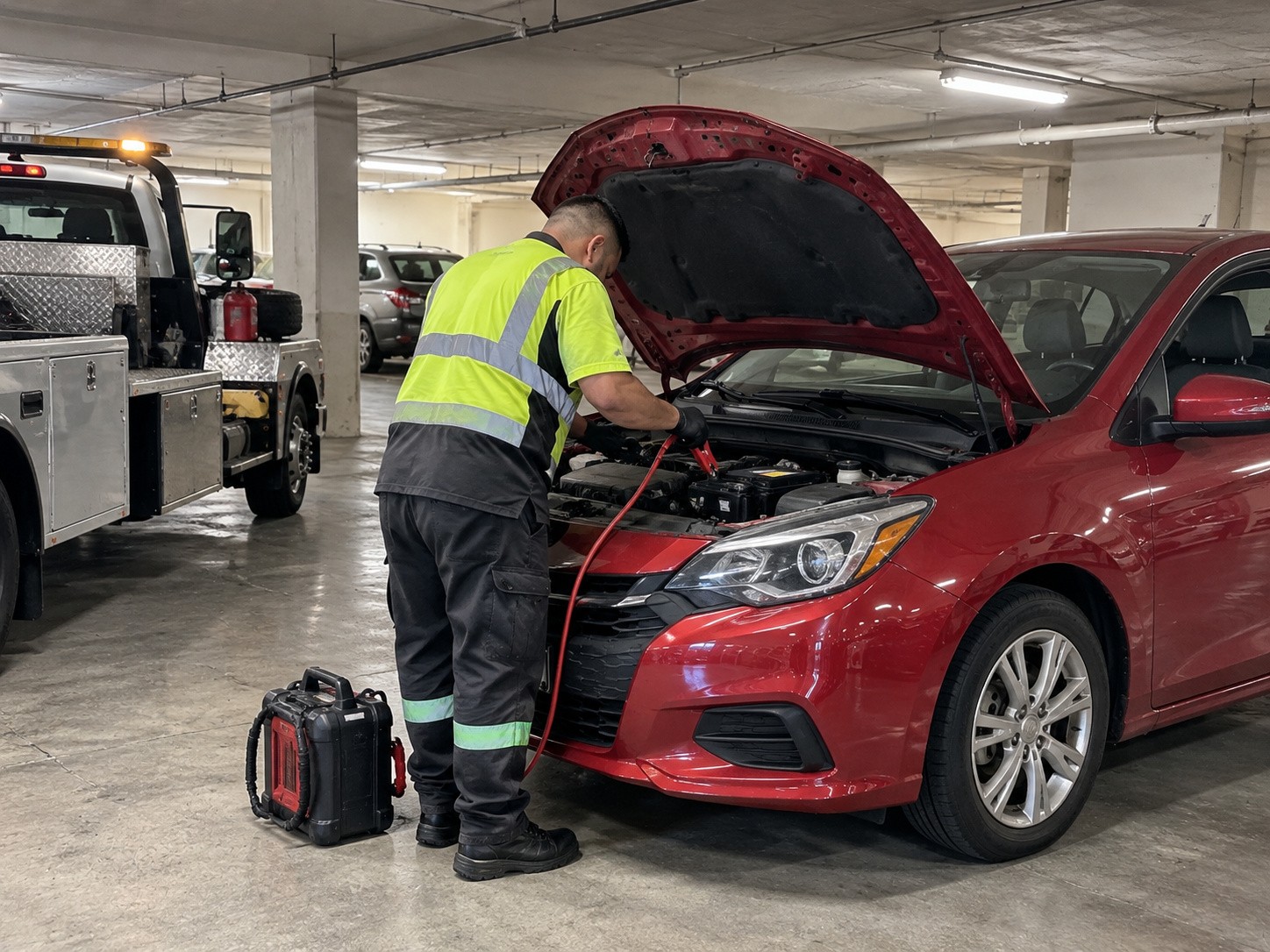
There are few things more frustrating than getting into your car, turning the key or pressing the start button, and having absolutely nothing happen: or worse, hearing a series of clicks, a weak crank, or an unusual sound that tells you something is clearly wrong. A car that won’t start can throw your entire day into chaos, whether it happens in your driveway first thing in the morning, in a parking lot after a long day of work, or in an unfamiliar part of the Greater Los Angeles area far from home.
Short answer: Most cars that won’t start have a dead or weak battery, a failing alternator or starter, an empty tank, or an ignition or fuel problem. Fast clicking usually points to the battery. Try a jump start first. If the car still won’t start, it needs a tow to a mechanic. In North Hollywood, call (747) 877-8577.
The tricky part about a car that won’t start is that there are many different reasons it can happen, and without the right knowledge it can be difficult to figure out what the problem actually is. Is it the battery? The alternator? The starter motor? A fuel issue? Something else entirely? Each of these problems has its own set of symptoms and its own solution, and knowing how to identify them can make a significant difference in how quickly and efficiently you can get the situation resolved.
The tricky part about a car that won’t start is that there are many different reasons it can happen, and without the right knowledge it can be difficult to figure out what the problem actually is. Is it the battery? The alternator? The starter motor? A fuel issue? Something else entirely? Each of these problems has its own set of symptoms and its own solution, and knowing how to identify them can make a significant difference in how quickly and efficiently you can get the situation resolved.
In this guide, we walk you through the most common reasons a car won’t start, how to identify which problem you might be dealing with, what you can do about it, and when it’s time to call a professional for help.
1. Dead or Weak Battery
How to identify it:
A dead or weak battery typically produces one of the following symptoms when you try to start your car. You may hear a rapid clicking sound when you turn the key. This is the starter motor trying to engage but not getting enough power from the battery to do so. You may hear a slow, labored cranking sound as the engine struggles to turn over. Or you may get no response at all (no sound, no lights, nothing) when you turn the key or press the start button.
You may also notice that your dashboard lights are dim or not illuminating at all, that your headlights are very weak, or that electrical components like your radio and power windows are not functioning properly. These are all signs that your battery does not have sufficient charge.
What to do about it:
If you suspect a dead battery, the first thing to try is a jump start. If you have jumper cables and another vehicle with a charged battery available, you can attempt to jump start your car yourself. If not, calling a roadside assistance service for a professional jump start is the quickest and easiest solution.
Keep in mind that if your battery keeps dying after being jump started, it is likely that the battery itself is failing and needs to be replaced. Most car batteries have a lifespan of three to five years, so if yours is approaching or past that age it may simply be time for a new one.
2. Faulty Alternator
While a dead battery is the most common culprit when a car won’t start, a faulty alternator is another frequent cause that is often mistaken for a battery problem. The alternator is the component responsible for recharging your battery while the engine is running. If the alternator is not working properly, the battery will gradually drain even while you’re driving and will eventually reach a point where there is not enough charge left to start the engine.
How to identify it:
A faulty alternator can be tricky to identify because its symptoms, particularly a dead or dying battery, closely resemble those of a straightforward battery problem. However, there are a few clues that can help you distinguish between the two. If your battery dies repeatedly even after being jump started or replaced with a new battery, a faulty alternator is a likely suspect. You may also notice warning lights on your dashboard, particularly the battery warning light, illuminating while you are driving, which can indicate that the alternator is not adequately charging the battery.
Other signs of a faulty alternator include dimming headlights while driving, electrical components behaving erratically, or a burning smell coming from under the hood.
What to do about it:
Unfortunately, a faulty alternator is not something that can be fixed on the roadside. If you suspect your alternator is the problem, the best course of action is to have your vehicle towed to a reputable auto repair shop where a mechanic can properly diagnose and replace the alternator. Continuing to drive with a failing alternator will only drain your battery further and risk leaving you stranded again.
3. Faulty Starter Motor
The starter motor is the component that physically cranks the engine when you turn the key or press the start button. When the starter motor fails, it can prevent the engine from turning over at all, leaving you with a car that simply won’t start no matter how many times you try.
How to identify it:
A faulty starter motor has a distinct set of symptoms that set it apart from a battery or alternator problem. The most telltale sign is a single loud click, rather than the rapid clicking associated with a dead battery, when you turn the key. You may also notice that nothing happens at all when you turn the key, even though your dashboard lights, headlights, and other electrical components are working perfectly fine. This is a key distinction. If your electronics are working normally but the engine simply won’t crank, the starter motor is a strong suspect.
In some cases, a failing starter motor may work intermittently, starting the car successfully some of the time but failing at other times. This on-and-off behavior is a classic symptom of a starter motor that is on its way out.
What to do about it:
A faulty starter motor requires professional repair and cannot be fixed on the roadside. If you suspect your starter motor is the problem, the safest and most practical solution is to call a towing company to have your vehicle transported to an auto repair shop for diagnosis and repair. Attempting to force a car to start with a faulty starter motor can sometimes cause further damage to the starting system.
4. Empty Fuel Tank
It might seem like an obvious one, but running out of fuel is a more common cause of a no-start situation than most drivers would like to admit. A faulty or inaccurate fuel gauge can make it appear that there is more fuel in the tank than there actually is, leading drivers to run out of gas without warning. In other cases, drivers simply misjudge how far they can go on a low tank and end up running dry before reaching a gas station.
How to identify it:
If your fuel gauge is reading at or near empty, or if you know you have been driving on a very low tank, an empty fuel tank is the most likely explanation for your car not starting. The engine may crank normally when you try to start it but fail to fire up, which is a classic sign that there is fuel in the lines being drawn through but the tank itself is empty or nearly empty.
What to do about it:
The solution to an empty fuel tank is straightforward. You need fuel. If you are close enough to walk safely to a gas station and can bring fuel back in an approved container, that is one option. Alternatively, calling a roadside fuel delivery service is a much more convenient and safer solution, particularly if you are stranded in a location that makes walking to a gas station impractical or unsafe. At Rosario Swift Towing Services, we offer fuel delivery service throughout North Hollywood and the surrounding Greater Los Angeles area to get you back on the road quickly and safely.
5. Faulty Ignition Switch
The ignition switch is the electrical component that activates the various systems your vehicle needs to start when you turn the key. When the ignition switch fails, it can prevent power from reaching the starter motor and other essential starting components, resulting in a car that won’t start.
How to identify it:
A faulty ignition switch can be particularly tricky to diagnose because its symptoms can overlap with those of a dead battery or faulty starter motor. However, there are a few specific signs that point toward the ignition switch as the culprit. If your dashboard lights flicker or fail to illuminate when you turn the key to the on position, but your battery and electrical system otherwise seem fine, the ignition switch may be at fault. You may also notice that the key feels loose, stiff, or unusual in the ignition, or that the car starts intermittently depending on the exact position of the key.
What to do about it:
A faulty ignition switch requires diagnosis and repair by a qualified mechanic. If you suspect this is the problem, call a towing company to have your vehicle transported to a repair shop. Do not attempt to force the key or manipulate the ignition switch, as this can potentially cause further damage or, in some cases, break the key off inside the ignition.
6. Fuel System Problems
Beyond simply running out of fuel, there are a number of fuel system issues that can prevent a car from starting. A clogged fuel filter, a failing fuel pump, or a problem with the fuel injectors can all result in the engine not receiving the fuel it needs to start and run properly.
How to identify it:
Fuel system problems can be difficult to diagnose without professional equipment and expertise. However, some common signs include an engine that cranks normally but fails to start, a sputtering or rough-running engine that eventually stalls and refuses to restart, or a noticeable loss of power and performance in the period leading up to the no-start situation. You may also hear a high-pitched whining sound from the fuel tank area, which can indicate a failing fuel pump.
What to do about it:
Fuel system problems require diagnosis and repair by a qualified mechanic with the appropriate diagnostic equipment. If you suspect a fuel system issue, call a towing company to have your vehicle transported to a repair shop. Attempting to start the car repeatedly with a fuel system problem can sometimes make the situation worse and potentially cause additional damage.
7. Flooded Engine
An engine flood occurs when too much fuel enters the engine’s cylinders, making it impossible for the engine to start. This is more common in older carbureted engines but can also happen in modern fuel-injected vehicles under certain circumstances. Most often when a driver repeatedly attempts to start a car that is having difficulty starting, pumping excess fuel into the engine in the process.
How to identify it:
A flooded engine typically produces a strong smell of gasoline when you try to start the car. The engine may crank normally but fail to fire, and you may notice that the more you try to start it, the worse the situation gets. If you have been repeatedly attempting to start a car that is struggling to start, there is a good chance the engine may be flooded.
What to do about it:
If you suspect a flooded engine, the first thing to do is stop trying to start the car, repeated attempts will only make the flooding worse. In many cases, waiting ten to fifteen minutes before trying again can allow some of the excess fuel to evaporate, giving the engine a better chance of starting. When you do try again, press the accelerator pedal fully to the floor while cranking the engine. This opens the throttle fully and allows more air into the engine, which can help clear the excess fuel. If the engine still refuses to start after these steps, calling a towing company and having it transported to a mechanic for proper diagnosis is the best course of action.
8. Seized Engine
A seized engine is one of the most serious and costly no-start situations a driver can face. Engine seizure occurs when internal engine components, typically the pistons, become stuck due to a lack of lubrication, extreme overheating, or physical damage. A seized engine is almost always the result of neglected maintenance, particularly failing to maintain adequate oil levels.
How to identify it:
A seized engine produces a very distinct symptom: when you try to start the car, the starter motor will engage but the engine will not turn over at all, producing a grinding or clunking sound rather than a normal cranking sound. In some cases, the starter motor fuse may blow as a result of the excessive resistance it encounters trying to turn a seized engine. If you have recently driven your vehicle with a low oil warning light illuminated, or if your engine was overheating before it stopped starting, a seized engine is a very real possibility.
What to do about it:
A seized engine is a serious mechanical failure that requires immediate professional attention. Do not attempt to force the engine to start, as this can cause further and potentially irreparable damage. Call a towing company right away to have your vehicle transported to a qualified mechanic for assessment. Depending on the extent of the damage, repair may range from a costly engine rebuild to a full engine replacement.
When Should You Call a Towing Company?
Not every no-start situation requires a tow: sometimes a jump start, a fuel delivery, or a simple fix is all that’s needed to get back on the road. However, there are situations where calling a towing company is clearly the right move:
Call a towing company if your vehicle has a suspected alternator, starter motor, ignition switch, or fuel system problem that cannot be resolved on the roadside. These issues require professional diagnosis and repair in a workshop environment.
Call a towing company if your vehicle has a seized engine or any other serious mechanical failure. Attempting to drive or force-start a vehicle with a serious mechanical problem can cause further and far more costly damage.
Call a towing company if your vehicle is in a location that makes it unsafe to wait for other types of roadside assistance, such as on a busy freeway or in an isolated area.
Call a towing company if you have tried the basic troubleshooting steps appropriate to your situation and the vehicle still refuses to start. At that point, getting a professional involved is the fastest and safest way to resolve the situation.
At Rosario Swift Towing Services, we provide fast, reliable towing and roadside assistance, including jump start service and fuel delivery, throughout North Hollywood and the surrounding Greater Los Angeles area. Whatever the reason your car won’t start, we’re here to help you get the situation resolved as quickly and smoothly as possible.
Car Won’t Start in North Hollywood or the Greater LA Area? Call Us Now.
Dead Batteries in Valley Heat
Summer days in the San Fernando Valley often go past 100 degrees, and heat is hard on car batteries. A battery can seem fine in spring and quit in August, especially if the car sits outside or in a hot parking structure. To lower the odds:
- Have the battery tested if it’s more than three years old
- Park in the shade or a garage when you can
- Keep the battery terminals clean and tight
- Don’t run the AC, radio and phone chargers with the engine off
If your car only clicks in a parking garage or on a street in North Hollywood, a jump start often gets you going right where you are.
Car Won’t Start in North Hollywood or the Greater LA Area? Call Us Now
Don’t let a no-start situation ruin your day. Whether you need a jump start, a fuel delivery, or a tow to the nearest repair shop, Rosario Swift Towing Services is ready to help. We serve drivers throughout North Hollywood and the surrounding Greater Los Angeles area, and we’re committed to getting to you quickly and resolving your situation professionally and efficiently. Give us a call at (747) 877-8577 or fill out our online form to request assistance. We’re here when you need us most.
Frequently Asked Questions
What does it mean if my car clicks but won’t start?
Fast clicking usually means the battery is too weak to turn the starter. A jump start often fixes it.
My car started after a jump. Do I still need a mechanic?
Have the battery and alternator tested soon. If the alternator isn’t charging, the car can die again while you drive.
Can you jump-start a car in a parking garage?
Yes, in most garages. When you call, tell us the level, the space number and the height limit on the entrance sign.
What if the jump start doesn’t work?
Then the problem is likely the starter, alternator, fuel or ignition. We can tow your car to your mechanic.
Related Services
Car Won’t Start in North Hollywood?
Available day and night. Or send a quote request and we’ll call you back.